
HOME SCHOOling


“A child enters traditional public school and is forced to learn how to fit into the system designed to educate all children. Homeschooling creates a tailored education to fit the needs of each unique and individual child.”
NEW TO HOME SCHOOLING? WHERE TO BEGIN
1. Understand the legal requirements for your state. Up-to-date information can be found on the Home School Legal Defense Association (HSLDA) website.
2. Define your purpose for homeschooling and your child's learning style. Cathy Duffy, a homeschool curriculum expert, offers a learning style assessment tool through the Cathy Duffy Reviews website.
3. Select curriculum and materials for your child's school year. Based on your child's learning style, consider the best options. I highly recommend Cathy Duffy's book, 103 Top Picks for Homeschool Curriculum. In it, she reviews top curriculum by subject or all-in-one options, which can be a great choice for a parent new to homeschooling. If you choose this option, these curriculum packages typically include all required materials. Whichever curriculum you choose, you can customize it to meet your child's needs.
4. Plan your school year. Once you've chosen curriculum materials for the year, you can develop a schedule. Traditional school calendars span 36 weeks with added holiday breaks between the months of August or September through May or June. The beauty of homeschooling is that you can customize it to fit your family. As long as you meet state requirements, you can plan to follow a traditional school schedule, school year-round, choose a 4- or 5-day week, etc.
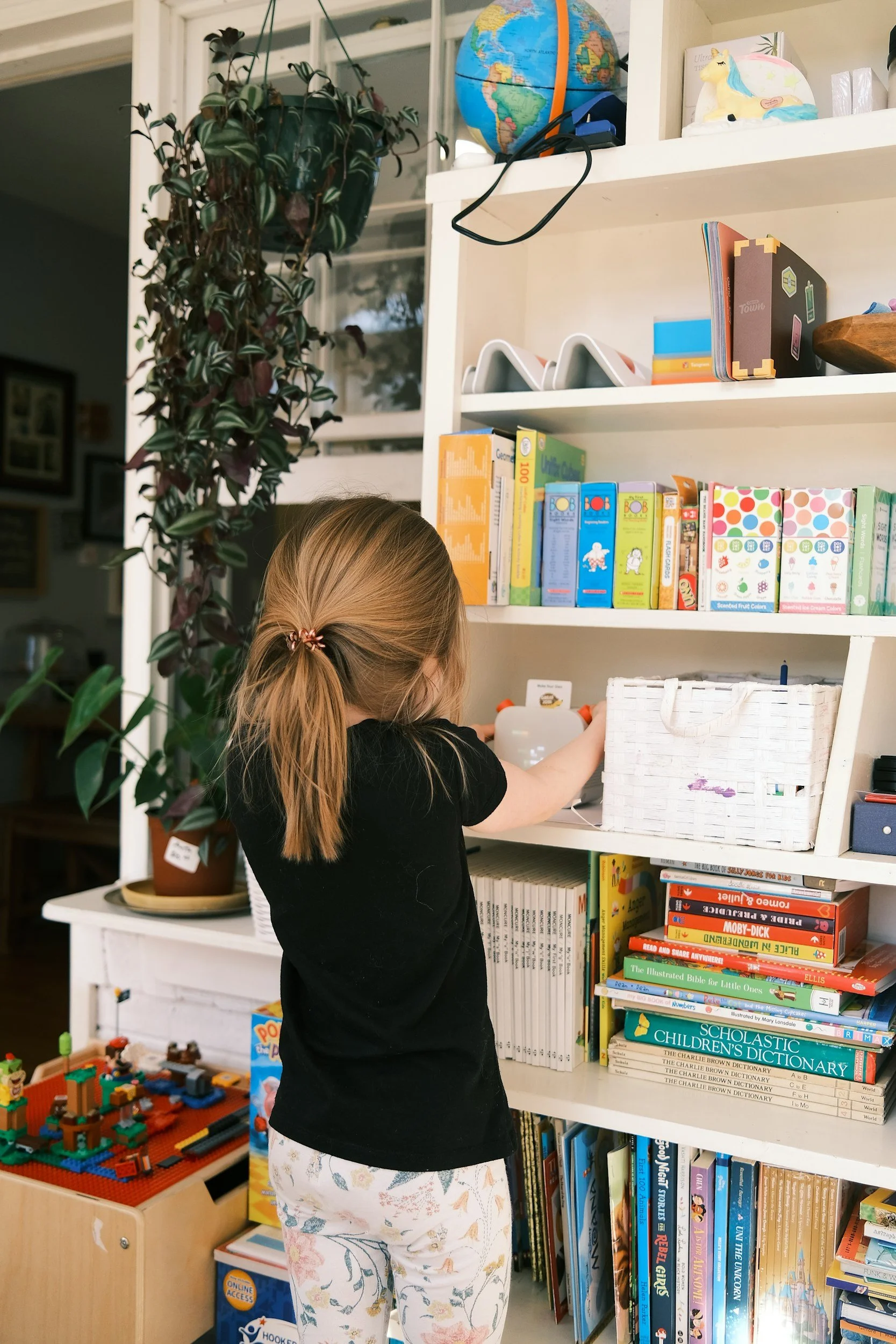
5. Organize a dedicated school space. Once you have a plan, decide where you'd like to do daily school work with your child. This can fit your available space. Some parents set up a "school room." This is a nice option, but by no means necessary! Most of our schooling happened on our living-room couch and coffee table. Our 36-week curriculum was organized on three dedicated shelves of our tall living-room bookshelf. Lesson plans were neatly divided into 6-week blocks between six three-ring binders. Next to our couch, weekly materials were organized each Monday in a book bin for easy access.
6. Plan your routine. Establish a preliminary, flexible daily schedule for how you'd like to cover each subject with your child. For example, we began each morning with Bible, then math (my son's least favorite to get it done early), followed by science, language arts, history, reading, etc. Do what works best for your child.
7. Connect with local support. Find local homeschool groups, co-ops, and supplemental classes. These are important hubs for social connections, resource sharing, and support. Being connected to others who homeschool makes all the difference for you and your child(ren)!
“The secret of getting ahead is getting started. The secret of getting started is breaking your complex overwhelming tasks into manageable tasks, and starting on the first one.”
“Reading furnishes the mind only with materials of knowledge; it is thinking that makes what we read ours.”

Academic evaluation
Academic evaluation methods for homeschooled students can vary by state and family. Some states have requirements about end-of-year academic testing or portfolio reviews. Some require no reporting at all. You can find your state's up-to-date requirements online from Home School Legal Defense Association (HSLDA).
Depending on your state's laws, some homeschooling parents evaluate their children's progress using informal methods, steering clear of traditional grading structures. Many choose to do a portfolio review with a certified teacher at the end of the school year. This can be an opportunity for the student to showcase a sampling of their work to a professional educator, where they receive feedback on academic progress. Parents can ask questions and receive guidance on any concerns. Overall, a portfolio review should be fun, informative, and celebratory. It's a great final wrap to a memorable school year!
Some states require—and many parents prefer—a nationally-normed academic achievement test. If you attended a traditional school, you'll remember taking these tests. Public school students often begin these formal assessments in third grade. Depending on their state, parents of homeschooled students may have multiple testing options. You may like to read more from HSLDA’s Testing & Evaluation page. Two common options are the Iowa Assessments or the Stanford Achievement Test. These assessments are traditional fill-in-the-bubble or online tests divided into subject area. A parent may administor these tests if they're certified to do so. Results are usually returned within a couple of weeks by the institution the test was purchased from.
Another excellent option is the Woodcock Johnson IV Test (WJ IV), which must be overseen by an approved administrator. Assessment results for the WJ IV align with those of other nationally-normed achievement tests, but it has the benefit of taking about 1 to 2 hours, allows for verbal answers, and provides immediate printed or emailed results. If there is an administrator near you, or available via online video meeting, this may be a preferable evaluation method for some students.
You must decide on the best option for your child according to your state law. Interestingly, though a typical concern about homeschooling is a lack of quality instruction, research demonstrates the opposite. Homeschooled students typically outperform their public school counterparts on nationally-normed college entrance exams like the SAT and ACT. However you assess your child, rest assured that if you are giving your best effort for their education, it is more than enough!
“The direction in which education starts a man will determine his future life.”

HIGH SCHOOL TRANSCRIPTS—FREE TEMPLATE!
Parents often feel insecure about the responsibility of high school transcript preparation for their homeschooled student because this document carries significant weight. It is the official permanent record of your student’s high school academic achievements used by employers and/or post-graduate institutions they may seek admission to, like trade schools, colleges, or universities.
Though it may feel daunting, transcript preparation is a standard compilation of student and school information, courses taken, grades achieved, semester and cumulative grade point averages (hint: there are apps available to easily calculate the GPA!), college entrance exam scores (if applicable), the grading scale you used, and a parent signature as school administrator. I want to encourage you: you are highly capable of creating your student’s transcript! It’s important to mention that if you prefer, there are paid transcript services available to homeschool parents. You can find these easily via a quick online search. Many homeschool parents choose this option to ease their load, and that’s understandable.
But if you’d rather save the money and create it yourself as the long-time record keeper for your student’s school years, you can certainly create a professional final transcript that will be accepted by any organization or institution requiring it. To get you started, I’ve created a customizable Microsoft Word template of the format I used successfully for my son’s official high school transcript. Enable editing to adapt it to your preferences as much as needed and save your finished transcript as a read-only PDF once it’s complete!
May it be a help to you as your student’s graduation nears so you can focus on celebrating all you’ve achieved together. Congratulations to you and your student on your tremendous accomplishment!
“For the things we have to learn before we can do them, we learn by doing them.”

REsources
Books:
103 Top Picks for Homeschool Curriculum: Choosing the Right Curriculum and Approach for Your Child’s Learning Style by Cathy Duffy
The First Year of Homeschooling Your Child: Your Complete Guide to Getting Off to the Right Start by Linda Dobson
Home Learning Year by Year: How to Design a Homeschool Curriculum from Preschool Through High School by Rebecca Rupp
Homeschoolers’ College Admissions Handbook: Preparing 12 - 18-Year-Olds for Success in the College of Their Choice by Cafi Cohen
Teach Your Own: The John Holt Book of Home Schooling by John Holt and Pat Farenga
The Ultimate Book of Homeschooling Ideas: 500+ Fun and Creative Learning Activities For Kids Ages 3 - 12 by Linda Dobson
What Your Kindergartner Needs to Know: Preparing Your Child for a Lifetime of Learning by E.D. Hirsch, Jr. and John Holdren
The Well-Adjusted Child: The Social Benefits of Homeschooling by Rachel Gathercole