
learning activities


The world is your classroom! Subject-area ideas I've compiled are intended to prompt your own creative thinking about the myriad methods that would best fit your child and family.
Reading, writing, & arithmetic!
Early Reading:
Reading is the foundation for education. It will be your child's life-long passport to discovery! Have patience with your child as they learn to read. Age of readiness and pace of understanding vary. Relish the time together. Hearing your child read their first sentence aloud is a milestone you'll treasure!
Research demonstrates the time-tested benefits of phonics-based reading instruction. One excellent program I've used is through Sonlight Curriculum, a Christian literature-based curriculum company.
Early reader books progress from beginner to more advanced levels (typically levels 1, 2, & 3). Seek out fun and engaging stories. Some timeless classics are must-haves: the Frog and Toad series, Dr. Seuss books, Little Bear, Owl at Home, and Mouse Soup.
Visit your local library. Children's librarians are available to offer guidance for young readers.
Sight words can be practiced with flash cards and repetition. Make a game of this with prizes.
Develop sight-word Bingo cards and game boards for a family game night.
Play Scrabble at your child's level of ability.
Have a scavenger hunt for objects in the same phonics family (HAT, CAT, MAT, etc.).
Praise small accomplishments with excitement! The more emphasis you place on the importance of your child's reading achievements, the more they'll want to read.
“Wear the old coat and buy the new book.”
“Perfect numbers like perfect men are very rare.”
MAth:
Children naturally have different degrees of interest and ability in math. I've known children who love the reliable logic of calculations and others who struggled to grasp basic concepts. For most young children, concrete visualization can help to establish a strong foundation to build on. Children on both ends of the spectrum will eventually be required to complete higher-math courses. Some high school students may even obtain college credit with AP courses.
From your child's earliest days, consider creative ways to make math relevant by applying it to daily tasks like cooking, grocery shopping, money counting, using an analog clock, measuring driving distance, etc.
When early math instruction begins, invest in a set of manipulatives, a learning clock, and play money, to give your child a visual representation of their math problems, which can feel abstract to some students.
Create a game out of memorizing addition, subtraction, multiplication, and division facts with flash cards and prizes.
Cut out colored houses from foam or mat board and label each house with an address number. Affix enough small velcro squares to accommodate the pairs of accompanying "occupants" that combine to equal each house's address number.
Seek out some math-based educational board games you can play with your child.
Use graph paper to help your child line up math problems. Children with sensory aversions often find red paper less alerting than white.
Early childhood math may not require the use of a standardized curriculum. By third grade, most students require a dedicated program. Decide which math curriculum style aligns with your child's needs. I have used an online subscription curriculum called Teaching Textbooks that covers grades 3 through 12. Its interactive online instruction is taught by the teachers who authored the program. It provides fun daily lessons, assignments, and tests, as well as automatic grading.
High school students benefit from a personal finance course as they near adulthood. Dave Ramsey offers an excellent program, Foundations in Personal Finance: Homeschool Edition, if you are interested in filling this need.
“There is no royal road to geometry.”
Handwriting:
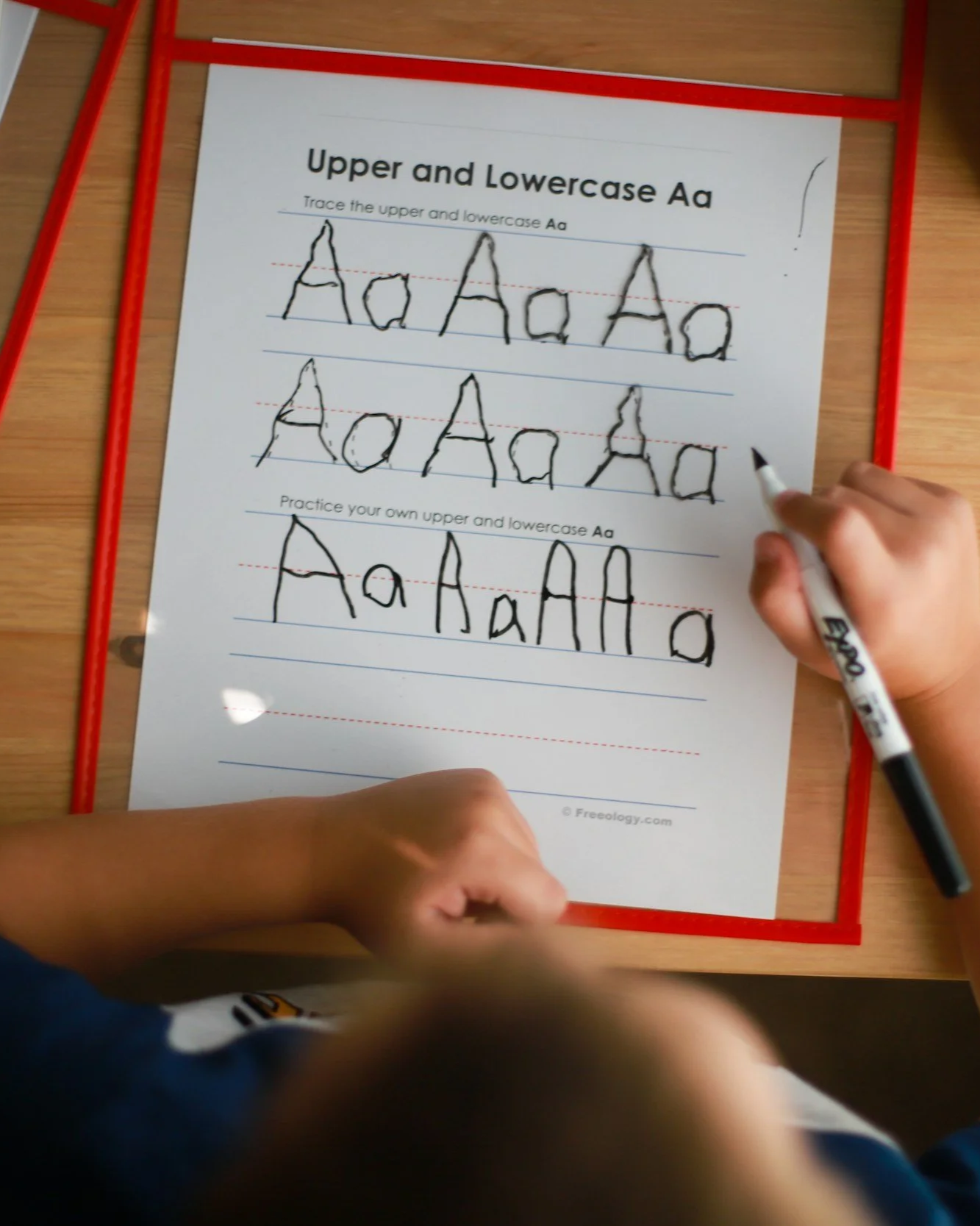
Handwriting has fallen on hard times in public schools. Sadly, some have removed cursive handwriting instruction entirely. Handwriting is important for more than the ability to sign our names. It is a necessary skill to read anything written in cursive, such as the original script of America's founding documents. Remarkably, when children practice handwriting, it has a direct impact on learning. Research shows that the brain favors writing (not typing) information down for the best long-term retention.
Invest in a high quality handwriting curriculum for young children. Handwriting Without Tears is an excellent program created by an occupational therapist. The several-year program provides necessary foundational skills.
Provide pencil grips if your child is struggling with holding their pencil properly.
Purchase early handwriting paper for practice on large lines, conducive to young children's developing fine motor skills.
Implement frequent (1 to 2 times weekly) brief copy work tasks on handwriting paper. Copying sentences from choice age-appropriate literary sources trains the child to recognize correct grammar, spelling, and sentence structure, and sets the stage for developing excellent written communication skills.
“Let the writing lesson be short; it should not last more than 5 or 10 minutes.”

Literature & writing—free diagram!
The best method for building great writers is to build great readers—the two cannot be separated. Instill a love of reading early. Read books beyond the child's ability aloud regularly. Discuss them. Read as much classic literature as possible. Study it. Prager U has compiled an excellent classic reading list by grade level.
Traditional writing instruction progressively incorporates many different types of writing. Mid-elementary students often begin writing book reports. As they progress, narrative short stories, research papers, and descriptive, expository, and persuasive essays are explored. Reading and writing poetry is an often overlooked element in education, but I urge you to invest time in this important endeavor. It's a worthwhile opportunity to enhance a child's overall writing skill, creativity, and emotional intelligence—and it's fun!
PARTS OF A STORY & PROGRESSION:
Begin writing instruction by teaching young children informally about the parts and progression of a story. The parts include: characters, setting, plot, conflict, and theme. In simplest terms for young children, the progression includes a beginning, middle, and end. As children grow, progression of character and story arcs become the focus. Your young child's favorite comic strip is a simple resource you can use to explain these basic concepts. Reinforce their understanding by discussing the story parts and progression of children's books.
THE WRITING PROCESS:
Incorporating age-appropriate assignments that instill an understanding of the writing process throughout a child's education will produce life-long skilled communicators.
Five steps to writing well:
1. PREWRITING: Brainstorm ideas, create an outline, and define purpose, audience, and key points through notes, an idea map, or research.
2. ROUGH DRAFT: Write a rough draft focusing on content and structure over grammatical perfection to capture the overall purpose.
3. REVISION: Revise for organization, flow, clarity, and content (Tip: reading it aloud is helpful!).
4. EDITING: Correct grammar, spelling, punctuation, and word choice for precision and readability.
5. FINAL DRAFT: A polished, finished essay is worth the work! I like for students to maintain an annual portfolio of the year's writing assignments as a representation of their different types of writing and growth.
ESSAY STRUCTURE:
Activity Idea: To teach my elementary-aged son the basic structure of an essay, I created a visual representation of the essay sections. His assignment was to write a descriptive essay about his future dream house. Together, we created a diagram of a house (see image) on small poster-sized board. Each floor represented one part of the essay: the attic (introduction), three middle floors (3 body paragraphs), and the basement (conclusion). A street sign at the top displayed his make-believe address (essay title). This was a great introduction to the standard five-paragraph essay structure most commonly used in middle and high school writing classes.
CURRICULUM & BOOK RECOMMENDATIONS:
The Elements of Stylebook by William Strunk Jr. and E.B. White
IEW (Institute for Excellence in Writing) Homeschool Curriculum is aptly named. They equip students to become highly-capable communicators.
On Writing Well: The Essential Guide to Mastering Nonfiction Writing and Effective Communication book by William Zinsser
SonlightCurriculum is a Christian literature-based K-12 curriculum company that provides an array of options ranging from all-in-one curriculum by grade level to a-la-carte choices. Their literature basis ensures an extensive selection of wonderful books with study guides to enhance meaningful discussions.
“The one great rule of composition is to speak the truth.”
Click on the image to enlarge and right click to save. May be printed for personal use.
science & History!
science:
Science is a step-by-step pursuit of knowledge through observation, experimentation, and logical reasoning. Hands-on learning is an educational buzzword for a reason. It cannot be separated from the study of the sciences because humans learn naturally by doing. And out of doing, the sciences were born. They stem from necessity or a desire for information that leads to processes, and eventually discoveries.
There is so much more we have to discover, and it can begin at home! Numerous science projects added abundantly to my son's education over our homeschooling years. They instilled lasting memories and enhanced his concrete understanding. We created rock candy, observed an ant farm, grew bacterial colonies in petri dishes, colored and pasted hand-drawn organs on a traced version of his paper body, and created slides to examine under our microscope, to name just a few. Science experiments bring applicability to life in exciting hands-on ways!
K-12 Science Education Branches:
LIFE SCIENCE
Biology: cells, organisms, heredity, and ecosystems
PHYSICAL SCIENCE
Physics: motion, forces, energy, and waves
Chemistry: matter, atoms, molecules, and reactions
EARTH & SPACE SCIENCE
Geology: earth and its elements
Meteorology: weather/climate
Astronomy: the solar system and universe
APPLIED SCIENCE
Engineering: technology and design solutions for real‑world problems
K-12 Science Educational Resources:
Explore the numerous available science curriculum options through the Cathy Duffy Reviews website.
The Northern Virginia Science Center Foundation, a non-profit organization that opened the Children's Science Center Lab in Virginia, has compiled an impressive list of science experiments you can do at home with your child. This is an invaluable resource to complement whatever science curriculum you're using!
If you have a local science museum and/or zoo, make time to visit—they frequently offer membership deals that are worthwhile.
The Magic Schoolbus cartoon series is an excellent children's science series.
Popular Mechanics for Kids, a 1997-2000 TV series, is another engaging science gem. All four seasons are currently available on the free Tubi app.

“There is a single light of science, and to brighten it anywhere is to brighten it everywhere.”

“Whoever wishes to foresee the future must consult the past; for human events ever resemble those of preceding times.”
history & geography
History isn't at the bottom of the page because it's least important. On the contrary—it's the foundation of everything else! Sadly, many people don't have fond memories of their history education (sometimes repurposed as social studies), likely because of the way history has traditionally been taught. Slogging through piecemeal textbooks of fragmented snapshots of the past seemed standard procedure. "Read these pages. Answer these questions," has been the basic protocol. Lacking meaning, the storing of these disjointed facts only served test-question recall. What’s been missing is an engaging story.
In reality, history is a treasured heritage—a fascinating global story of cultures, beliefs, and events—that forms the bedrock for everything we know. Internalizing its lessons is necessary for directing our world’s future. It contributes to the basis of our core values about shaping society. Ecclesiastes 1:9 says, "What has been will be again, what has been done will be done again; there is nothing new under the sun" (NIV).
How, then, should history be taught? Traditional methods teach young children to first understand their local surroundings—my town, my state, my country. But shifting the focus to begin history instruction with a global perspective will captivate a child's interest early and develop their broad understanding. The emphasis should always be on stories! Engaging literary works—not textbooks—should form the bulk of history education. Once a base knowledge has been established, the focus may be narrowed to a student's local place in the world. History should be at the core of all of education because it provides the rich background context for understanding our present world. There are so many ways to make it interesting and relevant!
Ideas to Bring History to Life!
Read great books! Stories, both non-fiction and historical fiction, have immeasurable value.
Dedicate time to relevant projects—hold a mock election, play dress-up with a home-made ancient Egyptian Pharoah hat and chest plate or use styrofoam cups to craft their canopic jars, create a diorama of a native American village, design African tribal masks, make a construction-paper Chinese lantern, use a roll of calculator paper or a notebook to fill in a historic timeline throughout the school year. The potential ideas are endless!
Visit a historical village for an immersive experience.
Visit a variety of history museums.
Communicate the significance of history by viewing and discussing children's history-themed series (Liberty's Kids is an excellent animated series on the American Revolutionary War, for example), age-appropriate historical films, and fascinating documentaries.
Read missionary stories about true adventurers, incorporating world cultures and beliefs with a faith perspective. Janet and Geoff Benge have written an extensive series of missionary stories for children. This is a set of the first five books: Christian Heroes: Then & Now.
Invest in a world and/or markable map to make a game out of discerning your child's knowledge of relevant geography.
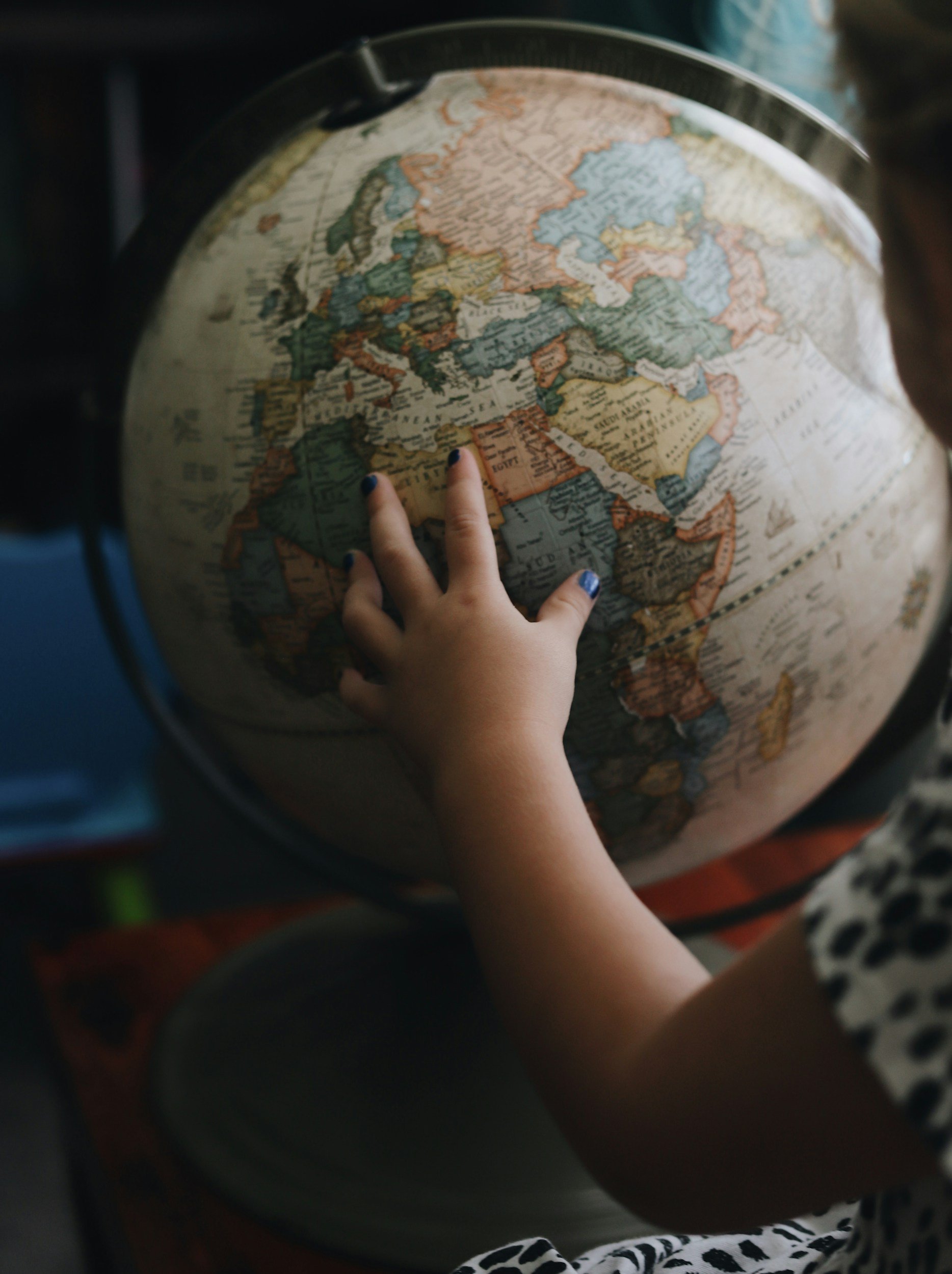
Have a detailed globe available to enhance understanding of the locations your child is learning about. Here’s an interactive globe from LeapFrog.
Research ethnic foods with your child as they learn about global cultures. Prepare culturally authentic meals together or visit ethnic restaurants.
Attend local cultural festivals.
Like the well-known Flat Stanley stories, have your child color a paper version of themself. Email a printable copy to friends and family and request that they share pictures of your child's flat counterpart’s geographical adventures. This can be great fun!
“If history were taught in the form of stories, it would never be forgotten.”